
NEDO Feasibility Study Program
Project overview
To address the construction of a sustainable and resilient social and economic structures, innovative technologies beyond conventional ideas are required. In particular, technologies and systems in the environmental and energy fields, such as solar panels and fuel cells, often require 30 years or more from basic research to practical implementation and societal integration. Therefore, in addition to promoting national projects aiming for practical applications around 2030, it is crucial to identify "technological foundations" targeted for a vision beyond 2040 and to foster the seeds of promising industrial technologies to ensure future international competitiveness.
Amidst the challenging competitive environment in recent years, private sector driving research and development in our country have prioritized results and it would be leading to shortened development periods. Initiating research and development projects taking more than 10 years to commercialize has become difficult. If this situation remains unchanged, there is a risk of a depletion of new technologies crucial for enhancing future industrial competitiveness and creating new industries through national projects.
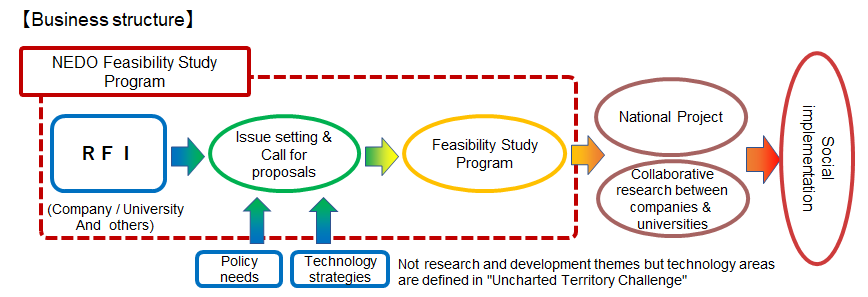
Hence, this program aims to discover and nurture fundamental technologies expected to be practical and socially implemented after 2040 (more than 15 years from the start of feasibility study). The goal is to promote these technology developments to collaborative research within the academia-industry framework, including national projects, contributing to the realization of decarbonized society and the creation of new industries.
Research and Development
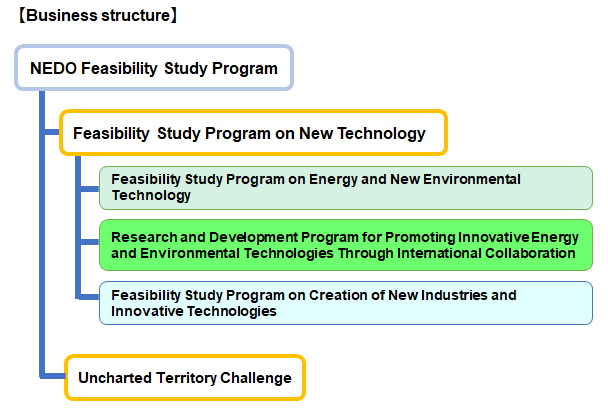
[Program Structure]
(1) Feasibility Study Program on New Technology
With the aim of realizing a decarbonized society and creating new industries, NEDO will discover and foster technology seeds with practical application and social implementation anticipated after 2040 (more than 15 years from the start of Feasibility Study Program). The implementation of feasibility study will be conducted to promote these technology developments to collaborative research within the academia-industry framework, including national projects.
[1] Feasibility Study Program on Energy and New Environmental Technology
We will conduct pioneering research with the aim of identifying and nurturing innovative technological seeds that are expected to be put into practical use and implemented in society by 2040 or later (more than 15 years after the start of the pioneering research), with a view to realizing a decarbonized society and creating new industries, and to fostering joint research through industry-academia collaboration, including national projects.
[Implementation period]
Up to three years
(Limited to projects that undergo a midterm evaluation in the second year and are approved to proceed into the third year.)
[Implementation system]
Collaborative frameworks involving industry and academia, such as those involving companies and universities.
[2] Research and Development Program for Promoting Innovative Energy and Environmental Technologies Through International Collaboration
We will conduct innovative technologies aimed at realizing a decarbonized society, with a view to practical application and societal implementation from 2040 onward, and based on the premise that Japanese universities and public research institutions will collaborate and cooperate with research institutions in other countries.
[Implementation period]
Up to three years
(Limited to projects that undergo a midterm evaluation in the second year and are approved to proceed into the third year.)
[Implementation system]
Collaborative frameworks involving industry and academia, such as those involving companies and universities, or frameworks consisting solely of universities and public research institutions
[3]Feasibility Study Program on Creation of New Industries and Innovative Technologies*
*)This program integrates the Feasibility Study Program on Creation of New Industries and Innovative Technologies and Feasibility Study Program on Materials and Biotechnology until FY2022.
We will conduct research on promising technologies aimed at creating new industries and innovative technologies, with a view to societal implementation 15 to 20 years or more after the start of the project.
[Implementation period]
Up to three years
(Limited to projects that undergo a midterm evaluation in the second year and are approved to proceed into the third year.)
[Implementation system]
Collaborative frameworks involving industry and academia, such as those involving companies and universities.
(2) Frontier Incubation Program
To foster innovation in new fields, we will focus on technologies in frontier areas*.
*)While this sector holds significant future potential, it is an area where investment is difficult for individual companies to pursue on their own—despite the government’s desire to prioritize investment—due to high risks such as technological development and market uncertainties, as well as the need for massive capital expenditures on research and development facilities.
[Implementation period and Project scale/type]
The implementing organization and project scale will be flexibly determined for each publicly solicited project based on the nature of the technology and its TRL level, among other factors.
[Implementation system]
Industry-academia collaboration frameworks; private companies only; universities and public research institutions only (provided that they are working to establish a framework for commercialization)
(3) Uncharted Territory Challenge *Previous name: Uncharted Territory Challenge 2050
We will conduct pioneering research aimed at identifying and developing innovative technological seeds—ideas that go beyond existing technologies and conventional thinking—to achieve drastic reductions in carbon dioxide emissions, greenhouse gas, with a view to the next 30 years following the launch of this initiative. The goal is to foster collaborative research through industry-academia partnerships, including national projects.
This project is driven by the following five research areas;
[1] Next-generation power electronics, [2] Energy and system sensing, [3] Conductive Materials and energy conversion materials, [4] Super lightweight and heat-resistant structural materials, [5] CO2 Effective Utilization.
[Implementation period]
Up to 5 years
(Limited to projects that undergo an interim evaluation in the second or third year and are approved to continue from the third or fourth year onward.)
[Implementation system]
Collaborative frameworks involving industry and academia, such as those involving companies and universities, or frameworks consisting solely of universities and public research institutions
(4) Request for Information (RFI) and Visionary Incubation Program (VIP)
As part of the Leading-Edge Research Program, we are issuing a Request for Information (RFI) to help defining the technical challenges for the upcoming call for proposals. The information provided will be used as a basis for defining these technical challenges, as well as for informing NEDO’s technology strategy and the review of other projects and programs.
Note: Due to scheduling constraints related to issue setting, RFI is conducted within specific timeframes (Information for the 2025 RFI can be found here).
RFI for "NEDO Feasibility Study Program"(Available only in Japanese)
We host VIP workshops focused on information submitted in response to RFIs that, even if they do not lead to the formulation of specific projects in the target fiscal year, hold the potential to deepen further discussion or generate new ideas (promising technological seeds). By facilitating discussions and sharing of technologies and societal visions among industry, academia, and government, we aim to foster and expand networks and communities around new technologies, thereby providing support that leads to future RFIs.
We held a total of five VIP sessions between May 23 and May 30, 2025.
Report of Visionary Incubation Program (VIP) workshop 2025 on "NEDO Feasibility Study Program on New Technology"(Available only in Japanese)
Report of Visionary Incubation Program (VIP) workshop 2024 on "NEDO Feasibility Study Program on New Technology"(Available only in Japanese)
Report of Visionary Incubation Program (VIP) workshop 2023 on "NEDO Feasibility Study Program on New Technology"(Available only in Japanese)
(5) Contact for Technical Proposals and Consultations
In addition to the Request for Information (RFI) mentioned above, we accept technical proposals and consultations online throughout the year. If you wish to submit a technical proposal or request a consultation, please email the consultation application form* with details of your proposal or inquiry to the address below.
*) The form will be provided upon request to the following addresses.
- [Email Address]
- ・Technical proposals and inquiries regarding the energy and environment sector, as well as inquiries regarding the Feasibility Study Program on Energy and New Environmental Technology: rfi-enekan[*]nedo.go.jp
- ・Proposals and inquiries regarding the Research and Development Program for Promoting Innovative Energy and Environmental Technologies Through International Collaboration: shinkakushin[*]ml.nedo.go.jp
- ・Technical proposals and inquiries regarding frontier sectors, as well as inquiries regarding the Frontier Incubation Program: frontier[*]ml.nedo.go.jp
- Please replace [*] with @ in the email addresses above.
Adopted Themes (Available only in Japanese)
Feasibility Study Program on Energy and New Environmental Technology
- List of themes adopted in FY2025(189KB)
- List of themes adopted in FY2024(173KB)
- List of themes adopted in FY2023(76KB)
- List of themes adopted in FY2022(80KB)
- List of themes adopted in FY2021(173KB)
- List of the 2nd adopted themes in FY2020(149KB)
- List of the 1st adopted themes in FY2020(158KB)
- List of themes adopted in FY2019(115KB)
- List of themes adopted in FY2018(180KB)
- List of themes adopted in FY2017(679KB)
- List of themes adopted in FY2016(55KB)
- List of the 2nd adopted themes in FY2015(137KB)
- List of the 1st adopted themes in FY2015(100KB)
- List of themes adopted in FY2014(109KB)
Research and Development Program for Promoting Innovative Energy and Environmental Technologies Through International Collaboration
Feasibility Study Program on Creation of New Industries and Innovative Technologies
- List of themes adopted in FY2025(101KB)
- List of themes adopted in FY2024(92KB)
- List of themes adopted in FY2023(56KB)
Former "Feasibility Study Program on New Technology for Creating New Industries
- List of themes adopted in FY2022(63KB)
- List of themes adopted in FY2021(76KB)
- List of themes adopted in FY2020(88KB)
- List of themes adopted in FY2019(41KB)
- List of themes adopted in FY2018(122KB)
Former "Feasibility Study Program on Innovative Technologies in Materials and Biotechnology"
- List of themes adopted in FY2022(46KB)
- List of themes adopted in FY2021(57KB)
Frontier Incubation Program
- List of themes adopted in FY2025(92KB)
Uncharted Territory Challenge
- List of themes adopted in FY2025(74KB)
- List of themes adopted in FY2024(88KB)
- List of themes adopted in FY2023(41KB)
Former “Uncharted Territory Challenge 2050“
- List of themes adopted in FY2022(87KB)
- List of themes adopted in FY2021(79KB)
- List of themes adopted in FY2020(97KB)
- List of themes adopted in FY2019(44KB)
- List of themes adopted in FY2018(32KB)
- List of themes adopted in FY2017(42KB)
Pamphlet (Available only in Japanese)
NEDO connect (Available only in Japanese)
NEDO connect provides information for everyone interested in industry-academia collaboration.
Basic information
| Technical field |
|
|---|---|
| Project code | P14004 |
| Department in charge |
|
Last Updated : June 1, 2026