
Extreme Materials Unlock New Technological Frontiers and Create New Markets
February 16, 2026
What if we could acquire materials durable enough to withstand ultra-high temperatures and pressures found deep underneath the Earth’s mantle, or create components generating magnetic forces exceeding today’s most powerful NdFeB magnets?
Such expectations are no longer confined to mere imagination. A new category of “extreme materials,” designed to enhance functional capabilities to unprecedented levels, is gaining increasing attention. In this context, “materials” are defined to encompass a broad range from raw substances and components to high-performance devices.
As specific examples, there are structural materials that remain stable at temperatures of several thousand degrees Celsius, where conventional metals would melt, and electromagnetic materials that can generate larger magnetic fields far beyond conventional magnets available today.
Such extreme materials, appearing almost as if they have emerged from science fiction and defy conventional wisdom, are drawing growing expectations as critical industrial technologies for the future of human society by addressing complex and formidable challenges.
NEDO is supporting R&D on extreme materials in order to strengthen the global competitiveness of Japan’s materials industry and contribute to establishing the technological foundations for achieving a sustainable society.
In particular, we have identified the new field, including extreme materials, as a frontier domain, launching a strategic call for R&D projects in 2025, then beginning various projects that will expand existing technological horizons.
Extreme materials resulting from this R&D will emerge as key pillars for technological innovation in the future of sustainable industry and society, directly impacting aerospace and energy efficiency, while also contributing to environmental sustainability, disaster resilience, and carbon neutrality.
Opening Up an Unprecedented New World with Extreme Materials
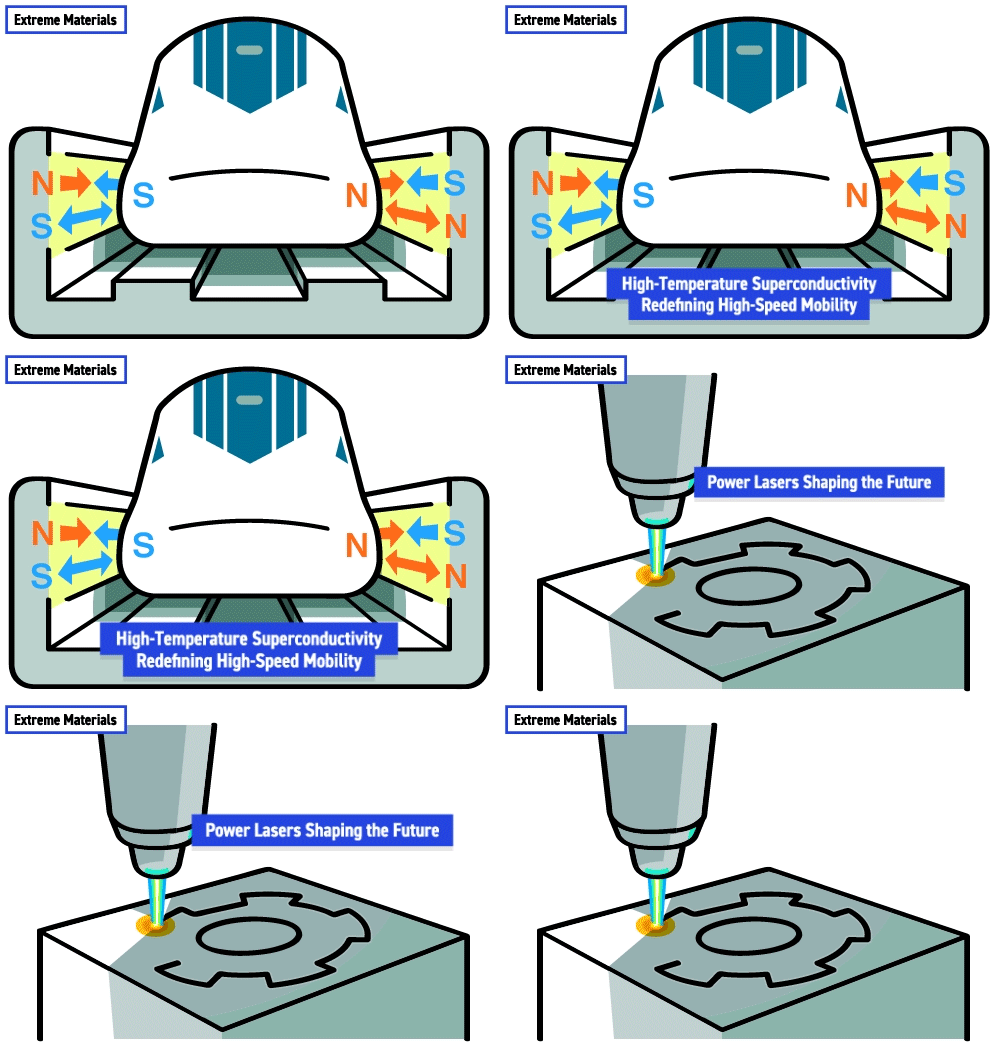
Examples of extreme-performance materials include high-temperature superconducting conductors, ceramic matrix composites, and ultra-high-performance optical materials.
High-temperature superconducting conductors, which achieve zero electrical resistance at liquid nitrogen temperatures, stand to enable the efficient generation of exceptionally strong magnetic fields. Composite materials capable of withstanding temperatures and pressures beyond conventional limits may be used in rockets and other aerospace applications, offering enhanced thermal resistance and radiation tolerance and significantly improving safety in space exploration.
Lightweight yet high-strength materials can reduce the weight of vehicles and aircraft, thereby lowering energy consumption and carbon emissions and supporting the transition to a decarbonized society. Advances in optical materials are enabling substantial increases in the output of power lasers, opening the door to more efficient and compact processing and cutting technologies and expanding the scope of laser-based applications.
Extreme materials have the potential to challenge conventional technological paradigms and open new possibilities for future technological development through innovation, leading to the development of a more sustainable society as well as new opportunities for business and industry.
Extreme materials will overcome technical constraints humanity has faced so far, and are likely to gain further attention as indispensable technological solutions for addressing global challenges in the future.
Potential for a ¥100 Trillion Market by 2040
From the perspective of market growth, extreme materials are also of significant importance. According to NEDO’s analysis, their share in the overall materials market will expand from approximately 5 % in 2022 to around 10 % by 2040, which corresponds to roughly ¥100 trillion in the global market.
Research activity is also accelerating. The number of academic publications related to extreme materials has grown at an average annual rate of 10.9 % over the past two decades, indicating that extreme materials are receiving growing international interest worldwide.
Japan has been engaged in materials research and development since the early stages of this field. Universities, research institutions, and companies across the country have contributed significantly to technological innovation. NEDO’s survey indicates that Japan accounts for nearly 50 percent of the global market share in extreme-performance materials, demonstrating that Japan has strong potential to remain at the forefront of this field.